
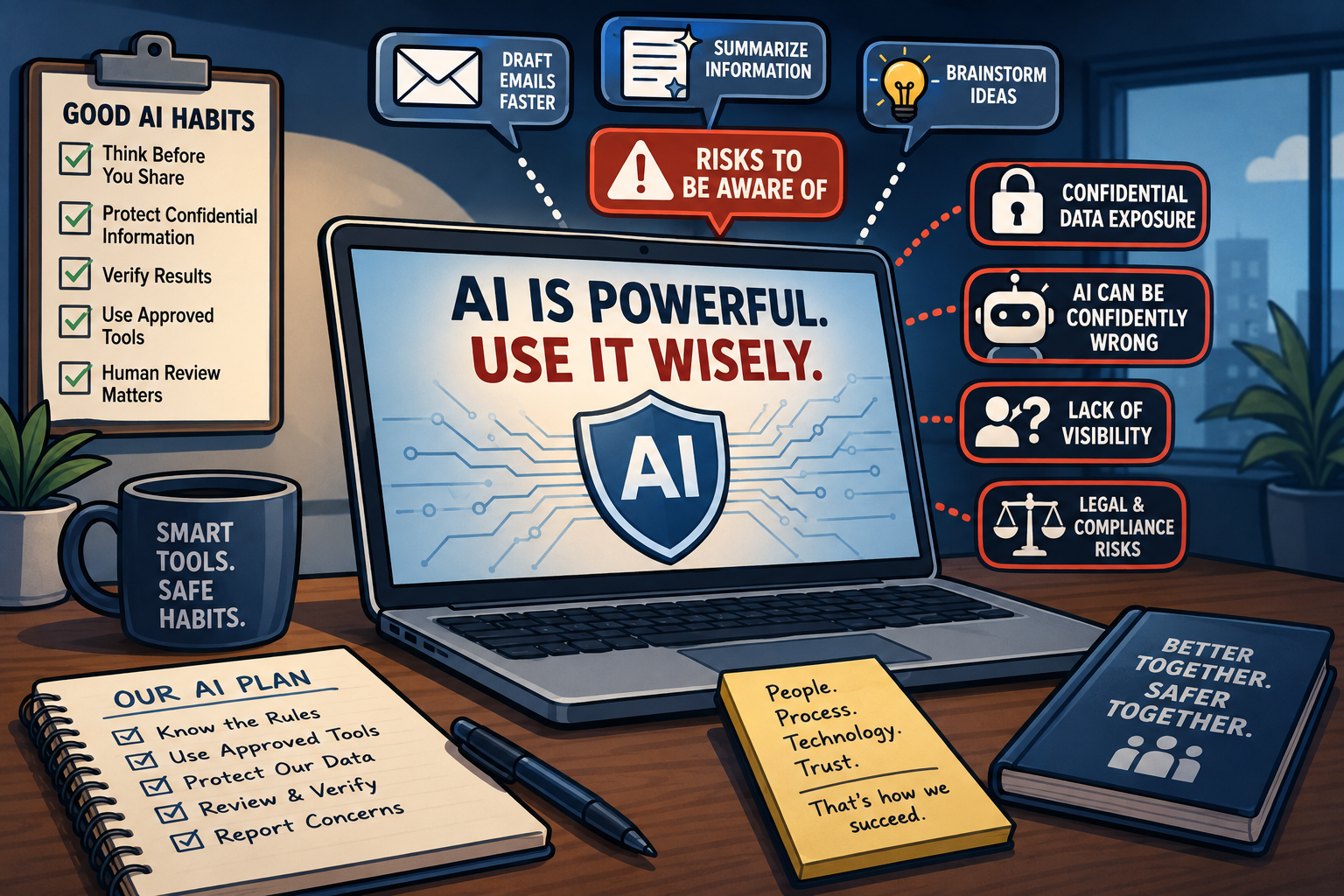
Artificial intelligence is no longer something organizations are simply preparing to use someday. It is already here.
Employees are using AI tools to draft emails, summarize documents, brainstorm ideas, prepare presentations, analyze information, write job descriptions, and complete countless other everyday tasks. In many cases, they are doing so because these tools help them work faster and overcome the challenge of starting with a blank page.
That can be a tremendous opportunity.
It can also create real risks when employees begin using AI without clear guidance from their organization.
The question is no longer whether your employees will use AI. The more important question is whether they understand how to use it safely, responsibly, and in a way that supports your organization..
AI Adoption Is Happening from the Bottom Up
Many technology initiatives begin with leadership. An organization evaluates a new platform, develops a rollout plan, trains employees, and then introduces the technology across the team.
AI adoption has often happened in the opposite order.
Employees discover tools on their own. They create personal accounts, experiment with different platforms, and begin incorporating AI into their daily work before leadership has formally discussed it.
One employee may use AI to polish a client email. Another may use it to summarize meeting notes. Someone else may upload a spreadsheet and ask the tool to identify trends.
Each person may simply be trying to become more productive. However, without organizational guidance, employees are left to make their own decisions about which tools are appropriate, what information can be shared, and when AI-generated content must be reviewed.
This creates what is often called “Shadow AI”—the use of AI tools without the organization’s knowledge, approval, or oversight.
The goal should not be to shame employees for exploring new technology. Their interest may reveal valuable opportunities to improve efficiency.
The goal should be to bring that activity into the open and provide a responsible framework for moving forward.nitor.
Not All Information Belongs in an AI Tool
One of the greatest concerns surrounding AI is the information employees may enter into it.
An employee might copy and paste a client email into a public AI platform to help draft a response. Another might upload financial information to create a summary. A manager could enter employee information while working on a performance review or job description.
These actions may feel harmless, especially when the employee is focused only on completing the task. However, the information could include:
- Confidential business information
- Personal employee or client data
- Financial records
- Donor or member information
- Legal documents
- Internal strategies
- Passwords or login information
- Protected or regulated data
Once information is entered into an unapproved tool, the organization may have limited visibility into how that information is processed, stored, or used.
Employees do not need to become AI security experts. They do need clear, practical direction about what information should never be entered into an AI platform.
A simple rule can be helpful:
Do not enter information into an AI tool unless you would be comfortable sharing that information outside your organization.
That rule may be intentionally cautious, but it gives employees a clear starting point while leadership develops more detailed guidance.
AI Can Be Confidently Wrongs
MAI-generated content can sound polished, professional, and convincing. That does not mean it is always accurate.
AI tools may misunderstand a question, omit important context, rely on incomplete information, or provide an answer that simply is not correct. These inaccurate responses are sometimes called hallucinations.
This becomes especially concerning when AI is used to prepare information involving legal matters, financial decisions, employee policies, client recommendations, healthcare information, or other high-impact areas.
AI can help generate a first draft. It should not automatically be treated as the final authority.
Human review remains essential.
Employees should verify important facts, review the tone and context of generated content, and ensure the final result reflects the organization’s standards and values.
AI is the tool. Human judgment is the safeguard.
A Complete Ban Is Rarely the Best Long-Term Strategy
When organizations first recognize the risks surrounding AI, the instinct may be to prohibit its use entirely.
That response is understandable, but it may not solve the underlying issue.
Employees may continue using AI through personal accounts or personal devices, making its use even more difficult to see and manage. A complete ban may also prevent the organization from benefiting from tools that could legitimately improve productivity, communication, and service.
A better approach is to define acceptable use.
Employees should know:
- Which AI tools are approved
- Which information may or may not be entered
- When AI-generated work must be reviewed
- Whether AI use should be disclosed
- Who to contact when they are uncertain
- Which tasks require additional approval
- How suspected mistakes or data exposure should be reported
The policy does not need to anticipate every possible scenario.
It needs to give employees enough direction to make better decisions and enough confidence to ask questions before taking unnecessary risks.
Start with a Conversation, Not Just a Policy
An AI policy is an important step, but a document alone will not create responsible habits. Organizations should also talk openly with employees about how they are already using AI.
Consider asking your team:
- Which AI tools are you currently using?
- What tasks are you using them for?
- Where has AI helped you save time?
- What concerns or questions do you have?
- Which repetitive tasks could potentially be improved?
- Where do you believe human review is especially important?
These conversations can help leadership understand what is already happening across the organization. They may also uncover valuable use cases that leadership had not considered.
Perhaps an employee is spending several hours each week preparing routine meeting summaries. Maybe someone is repeatedly answering the same internal questions. Another employee may be struggling to organize information spread across multiple documents.
These are opportunities worth exploring—but they should be explored intentionally.
Five Steps to Build a Responsible AI Plan
Organizations do not need to have every answer before getting started.
A practical AI plan can begin with five steps.
1. Understand Current AI Use
Ask employees which tools they are using and how they are using them. Create an environment where people feel comfortable answering honestly.
You cannot manage what you do not know about.
2. Identify Approved Tools
Evaluate which AI platforms align with your organization’s security, privacy, and operational needs.
Whenever possible, use business-grade tools that provide appropriate administrative, privacy, and data-protection controls.
3. Create an AI Acceptable-Use Policy
Document your expectations in clear, everyday language.
Avoid creating a policy filled with technical or legal terminology that employees will struggle to understand. Focus on practical examples and decisions they are likely to encounter.
4. Train Your Team
Show employees how AI can be used productively as well as where caution is required.
Training should include examples involving confidential information, inaccurate output, biased responses, copyright concerns, and the importance of human review.
5. Start Small and Review Regularly
Choose a few low-risk use cases and evaluate the results.
AI technology is changing quickly. Your policies, approved tools, and training should be reviewed regularly as the technology and your organization’s needs evolve.tion.
The Time to Create a Plan Is Now
AI is moving too quickly for organizations to ignore.
Waiting until there is a problem—a confidential document is uploaded, inaccurate information is shared, or an employee begins relying too heavily on an unapproved platform—is not a strategy.
Your organization does not need a perfect AI program on day one. It does need a starting point.
Begin by understanding how employees are already using AI. Establish a few clear boundaries. Select appropriate tools. Train your team. Then continue improving your approach as you learn.
AI can create meaningful opportunities for small businesses and nonprofits, but its value depends on how thoughtfully it is introduced and managed.
Your employees are already exploring what AI can do. Now is the time to make sure your organization has a plan.
Final Thoughts
Design Data Technology Partners can help your organization evaluate current AI use, develop practical policies, select secure tools, and prepare your team to use AI responsibly.
We are ready whenever you need us!